White Trillium
Family: Melanthiaceae - Genus: Trillium - Species: T. grandiflorum
Other names: Large-flowered Trillium, Great White Trillium, Wake-robin
Quick facts
- Uses
- Wildlife
- Edible parts
- None
- Type
- perennial herb
- Flowers
- Apr–May
- Height
- 20–45 cm
- Native to
- Eastern North America
- Habitat
- rich hardwood forests, shady slopes
| Month | Observations |
|---|---|
| January | 1 |
| February | 0 |
| March | 343 |
| April | 8517 |
| May | 17575 |
| June | 860 |
| July | 70 |
| August | 54 |
| September | 14 |
| October | 14 |
| November | 1 |
| December | 1 |
White trillium carpets hardwood forests in spring, often in such numbers that the forest floor looks dusted with snow. It's the provincial flower of Ontario, and one of the best-loved wildflowers in eastern North America.
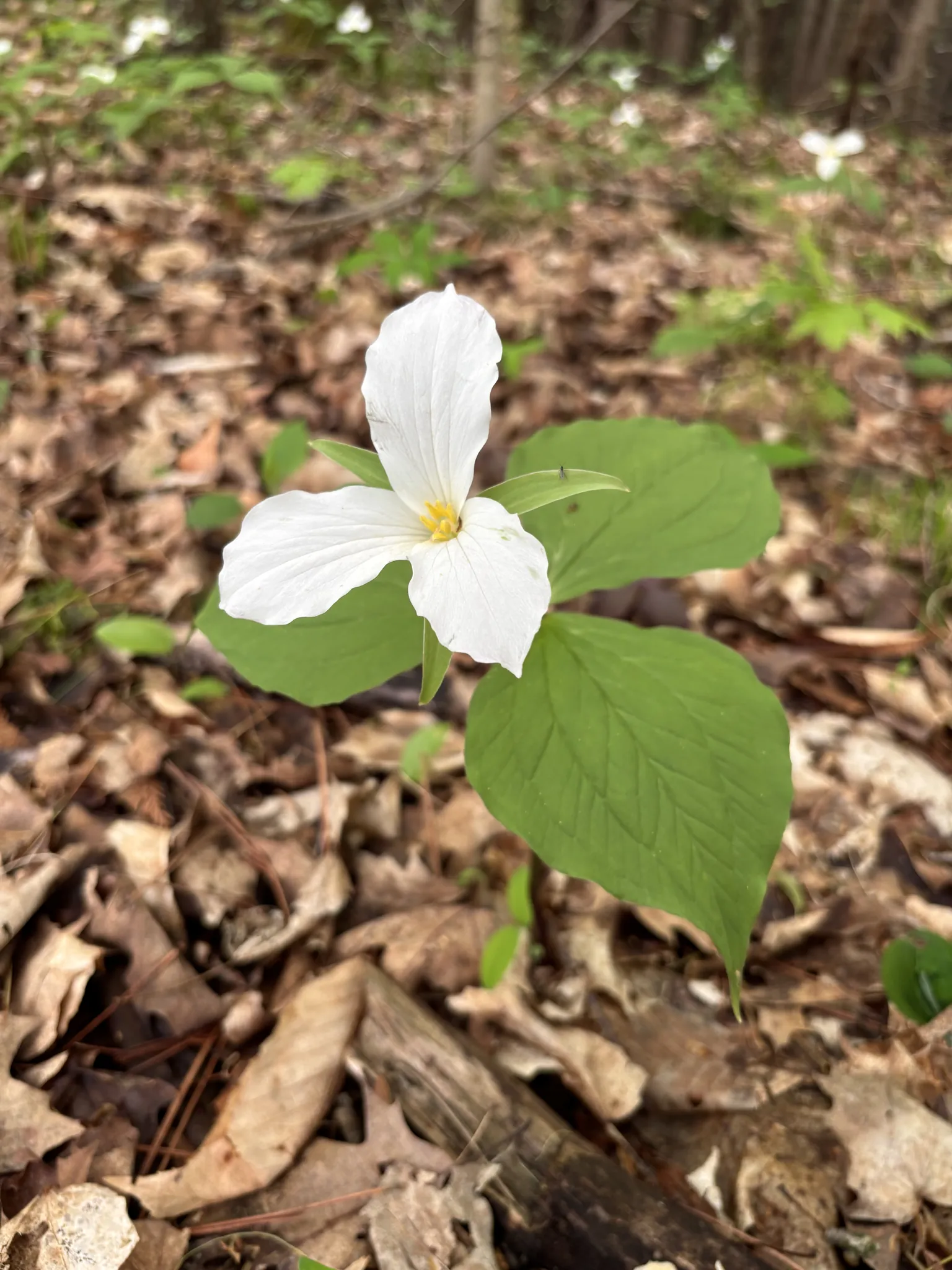
Everything about it comes in threes: three leaves, three green sepals and three white petals.
How to spot it
- Leaves are broad and pointed, in a single whorl of three around the stem.
- The flower sits on a short stalk above the leaves. It has three large, wavy white petals and a yellow centre.
- Ageing flowers slowly turn pink as they fade, so a patch can look pink and white at the same time.
- Fruit is a single green berry in summer, after the flower has gone.
What it's good for
Mostly, it's for looking at. Trillium is very slow to grow: a seed can take seven years or more to become a flowering plant. Its seeds have a small, fatty attachment that ants love, so ants carry them off and plant them across the forest floor.
Leave it be
The leaves are the plant's only source of food for the year. Pick the flower and you take the leaves too, and the plant can take years to recover or may die. It's protected in many parks. Enjoy it where it grows.
Gallery
Single white flower above a whorl of three leaves
Where it grows
Each hexagon shows how many times White Trillium has been recorded there, from herbarium specimens, surveys and iNaturalist photos. Gaps can mean nobody has looked, not that the plant is absent.