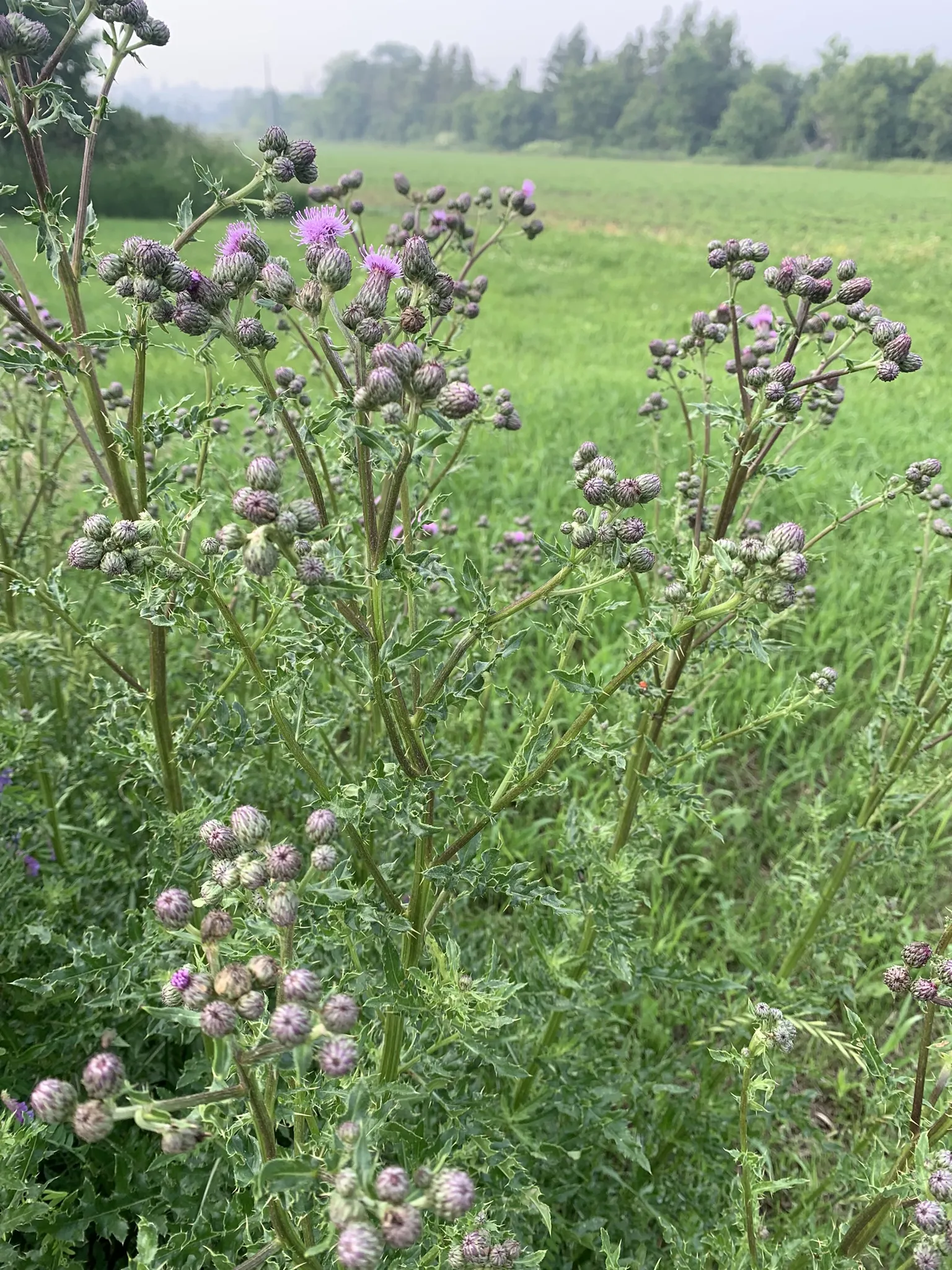
Bull Thistle
Family: Asteraceae - Genus: Cirsium - Species: C. vulgare
Other names: Spear Thistle, Common Thistle, Hard Thistle, Hare Thistle, Hercules Thistle, Hock About, Horse Thistle, Plume Thistle
Quick facts
- Uses
- Edible
- Edible parts
- stem, root, leaf
- Type
- biennial herb
- Flowers
- Jun–Oct
- Height
- 60–150 cm
- Native to
- Europe and Asia
- Habitat
- pastures, roadsides, disturbed ground
| Month | Observations |
|---|---|
| January | 17 |
| February | 21 |
| March | 17 |
| April | 18 |
| May | 46 |
| June | 244 |
| July | 1621 |
| August | 2311 |
| September | 1062 |
| October | 323 |
| November | 88 |
| December | 35 |
Bull thistle is the big, fierce thistle of pastures and roadsides. Every part of it seems to be armed with spines, and cattle leave it alone, which is why it can take over a field.
It takes two years to grow. In the first year it lies flat in a spiny rosette. In the second it grows a tall stalk topped with purple flowers.
How to spot it
- Leaves are deeply lobed, and each lobe ends in a long, sharp spine. The top of the leaf is rough and prickly, like sandpaper.
- Stems have spiny wings running down them from the base of each leaf.
- Flowers are big purple tufts, 3–5 cm across, sitting on a spiny, rounded base.
- Seeds float away on feathery white down.
What it's good for
If you're brave enough, thistle is edible. Cut the young stalk of a second-year plant before it flowers and peel away every spine. The inside tastes like celery crossed with artichoke. First-year roots can be cooked, and the leaf midribs can be eaten once the spines are trimmed off.
It's also great for wildlife. Bees and butterflies love the flowers, and goldfinches eat the seeds and line their nests with the down.
Other thistles
- Canada thistle has smaller, pale purple flowers in clusters and spreads by its roots. Its stems have no spiny wings.
- Milk thistle is a different plant, with white-marbled leaves. It's the thistle that herbal liver remedies are made from, not this one.
Gallery
Plant with purple flower heads and buds Spiny, lobed leaves Low rosettes of spiny leaves Spiny, winged stem
Where it grows
Each hexagon shows how many times Bull Thistle has been recorded there, from herbarium specimens, surveys and iNaturalist photos. Gaps can mean nobody has looked, not that the plant is absent.